
A Put Broken Wing Butterfly is a put butterfly with unequal distances between its strikes. The version below uses a wider lower wing and is opened for a credit. That credit leaves a small profit if the stock rises, while a large decline can produce the maximum loss.
Names and related structures: Put skip-strike butterfly; unequal-wing put butterfly.
Market Outlook
The trader wants the stock to finish near the middle strike, with some tolerance for a rise. This makes the credit version neutral to mildly bullish when its strikes are placed below the current stock price. Its largest profit still occurs at one specific price at expiration.
Position Construction
Buy one lower-strike put, sell two middle-strike puts and buy one higher-strike put. Use one expiration, with the lower wing wider than the upper wing.
| Action | Option | Expiration | Premium |
|---|---|---|---|
| Buy 1 | $90 put | Same expiry | $2 |
| Sell 2 | $100 put | Same expiry | $5 |
| Buy 1 | $105 put | Same expiry | $7 |
Example
With XYZ at $100, buy the $90 put for $2, sell two $100 puts for $5 each and buy the $105 put for $7. This collects $100. At $100, the $105 put pays $500 and the remaining puts expire worthless, giving a $600 profit. At $90, the long $105 put pays $1,500 while the two short puts cost $2,000, leaving a $400 net loss after the credit.
All amounts use a 100-unit contract multiplier and exclude commissions and fees. These prices illustrate the arithmetic; they are not current market quotes.
Payoff Diagram
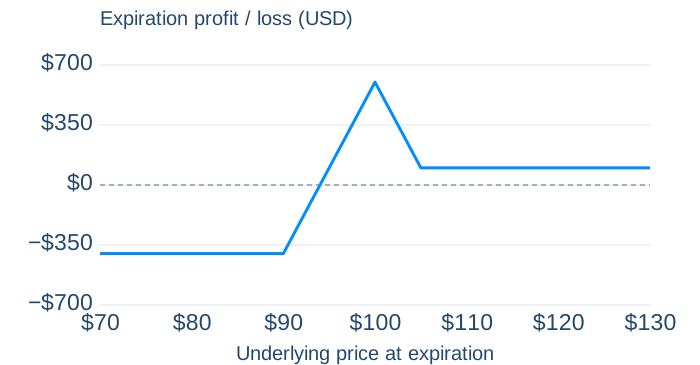
| Underlying price | Expiration P/L |
|---|---|
| $80 | −$400 |
| $90 | −$400 |
| $94 | $0 |
| $100 | $600 |
| $105 | $100 |
| $120 | $100 |
Maximum Profit
Maximum profit = (higher strike − middle strike + credit) × 100. For these strikes and premiums, the maximum is $600 at $100 at expiration.
Maximum Loss
Maximum loss = (lower wing width − upper wing width − credit) × 100, if positive. It is $400 at $90 or below in this example. At $105 or above, every put expires worthless and the $100 credit remains.
Breakeven Point(s)
The example breaks even at $100 − $5 − $1 = $94. For this credit arrangement, subtract the upper wing width and credit from the middle strike. The answer must fall inside the lower wing; otherwise inspect the full payoff. Debit versions have different outcomes.
Risks and Position Management
The wider lower wing leaves exposure to a sharp selloff. A short put assignment requires purchasing shares, even if another option limits the modeled expiration loss. Separately closing or rolling a leg changes both the payoff and the amount at risk.
Before expiration, option prices also reflect time remaining and volatility. The expiration diagram does not show every interim gain or loss. Trading costs reduce profits and increase losses. Review the contract’s exercise and settlement rules before trading.
Explore the Position
Open this example in the Advanced Strategy Builder. The example legs, quantities and premiums are filled in so you can change them and compare expiration outcomes.
Related Strategies
Compare This Strategy
Optional further reading to help you compare the tradeoffs.
- Butterfly vs Broken Wing vs Broken Heart Butterfly — First decide where the stock is expected to finish.
- Call vs Put Broken Wing Butterfly — Choose the vulnerable side deliberately.
Structure reference: Strategy reference. Example premiums and calculations are illustrative. Editorial standards.
Advanced Strategy Variations
Build on the core strategies with these less common structures. Match the option legs and expirations when comparing names.