
A Broken Heart Butterfly separates the two short strikes of a broken wing butterfly. The result has four strikes and a flat maximum-profit zone, rather than a single peak. Structurally, it is a Condor with unequal wing widths; the name describes this particular variation.
Names and related structures: Disconnected broken wing butterfly; unequal-wing Condor.
Market Outlook
The trader targets the gap between the two short strikes. In the credit call version below, a fall still leaves a small profit, while a sufficiently large rise causes a loss. Moving the strikes changes the directional bias, so the name alone does not identify a bullish or bearish trade.
Position Construction
Combine a lower-strike Bull Call Spread with a higher-strike Bear Call Spread that has a wider strike interval. Use one contract at each strike and a common expiration. The two short calls are at different strikes.
| Action | Option | Expiration | Premium |
|---|---|---|---|
| Buy 1 | $95 call | Same expiry | $8 |
| Sell 1 | $100 call | Same expiry | $6 |
| Sell 1 | $105 call | Same expiry | $4 |
| Buy 1 | $115 call | Same expiry | $1 |
Example
Buy the $95 call for $8, sell the $100 call for $6, sell the $105 call for $4 and buy the $115 call for $1. The $5-wide Debit Spread costs $200 and the $10-wide Credit Spread receives $300, leaving a $100 credit. Between $100 and $105, the lower spread pays $500 while the upper spread expires worthless: profit is $600. At $115 or above, net loss is $400.
All amounts use a 100-unit contract multiplier and exclude commissions and fees. These prices illustrate the arithmetic; they are not current market quotes.
Payoff Diagram
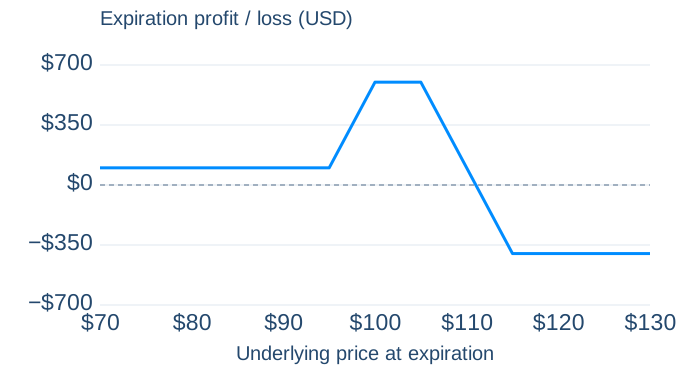
| Underlying price | Expiration P/L |
|---|---|
| $80 | $100 |
| $95 | $100 |
| $100 | $600 |
| $105 | $600 |
| $111 | $0 |
| $115 | −$400 |
| $125 | −$400 |
Maximum Profit
Maximum profit = (Debit Spread width + opening credit) × 100. The example earns $600 anywhere from $100 to $105 at expiration. Separating the short strikes widens this zone, but does not automatically improve the available premium or return on risk.
Maximum Loss
Maximum loss = (Credit Spread width − Debit Spread width − opening credit) × 100, if positive. The example risks $400 at $115 or above. At $95 or below it keeps the $100 credit.
Breakeven Point(s)
The upper breakeven is the short call of the Credit Spread + Debit Spread width + credit: $105 + $5 + $1 = $111. This formula applies to the credit version shown and assumes the result lies inside the wider wing.
Put Broken Heart Butterfly
The put version reverses the arrangement. For example, buy a $85 put, sell a $95 put, sell a $100 put and buy a $105 put. With a $1 total credit, maximum profit is $600 between $95 and $100; maximum loss is $400 below $85; breakeven is $89. Above $105, the credit is retained. These are unequal-wing Condor payoffs, not an extra hedge against every possible move.
Risks and Position Management
The wider Credit Spread determines the vulnerable tail. Four separate strikes can make the position harder to fill at the desired price. Closing one spread early leaves a different position, and short-option assignment can create stock exposure before the protective options are exercised.
Before expiration, option prices also reflect time remaining and volatility. The expiration diagram does not show every interim gain or loss. Trading costs reduce profits and increase losses. Review the contract’s exercise and settlement rules before trading.
Explore the Position
Open this example in the Advanced Strategy Builder. The example legs, quantities and premiums are filled in so you can change them and compare expiration outcomes.
Related Strategies
Compare This Strategy
Optional further reading to help you compare the tradeoffs.
- Butterfly vs Broken Wing vs Broken Heart Butterfly — First decide where the stock is expected to finish.
Structure reference: Strategy reference. Example premiums and calculations are illustrative. Editorial standards.
Advanced Strategy Variations
Build on the core strategies with these less common structures. Match the option legs and expirations when comparing names.