
ZEBRA stands for Zero Extrinsic Value Back Ratio. A Call ZEBRA buys two in-the-money calls and sells one near-the-money call, choosing premiums that approximately offset the time value paid and received. It is a bullish stock-replacement position with a limited initial debit at risk.
Names and related structures: Zero Extrinsic Value Back Ratio; Call ZEBRA; Put ZEBRA.
Market Outlook
A Call ZEBRA seeks a rise in the stock. A Put ZEBRA reverses the direction and seeks a decline. Near-stock-like initial delta is a construction target, not a permanent relationship: delta changes as price, time and volatility change.
Position Construction
For a Call ZEBRA, buy two lower-strike in-the-money calls and sell one higher-strike near-the-money call, all expiring together. This differs from the existing Call Backspread guide, which places the two long calls above the short call.
| Action | Option | Expiration | Premium |
|---|---|---|---|
| Buy 2 | $90 call | Same expiry | $12 |
| Sell 1 | $100 call | Same expiry | $4 |
Example
With XYZ at $100, buy two $90 calls for $12 each and sell one $100 call for $4. The debit is $20 per share, or $2,000. Each long call contains $10 intrinsic value and $2 time value; the $4 received offsets the two $2 time values. At $110, the options have $3,000 net intrinsic value, so profit is $1,000. At $95, they are worth $1,000, leaving a $1,000 loss.
All amounts use a 100-unit contract multiplier and exclude commissions and fees. These prices illustrate the arithmetic; they are not current market quotes.
Payoff Diagram
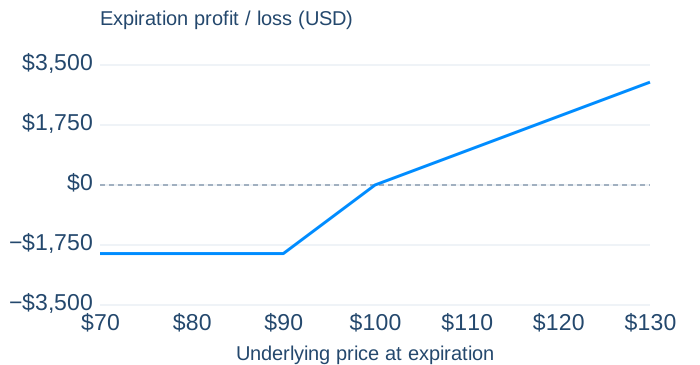
| Underlying price | Expiration P/L |
|---|---|
| $70 | −$2,000 |
| $90 | −$2,000 |
| $95 | −$1,000 |
| $100 | $0 |
| $110 | $1,000 |
| $120 | $2,000 |
Maximum Profit
Call ZEBRA profit is unlimited as the stock rises. Above the $100 short strike in this example, profit equals (stock price − $100) × 100. Below that strike, the position does not behave like 100 shares.
Maximum Loss
The call example can lose the entire $2,000 debit at $90 or below at expiration. The two long calls cover the one short call in this matched structure. This limit assumes the options are kept together or closed together without leaving assigned shares unhedged.
Breakeven Point(s)
The example breaks even at $100. More generally, solve 2 × max(S − lower strike, 0) − max(S − higher strike, 0) = debit. With imperfect time-value offset, the breakeven need not equal the stock price at entry.
Put ZEBRA
For a bearish example with stock at $100, buy two $110 puts for $12 each and sell one $100 put for $4. The $2,000 debit breaks even at $100, earns $1,000 at $90 and is fully lost at $110 or above. Unlike the call version, maximum profit is finite: $10,000 if the stock reaches zero. The two examples use hypothetical premiums, not interchangeable market quotes.
Risks and Position Management
Zero net time value at entry does not mean zero time decay or no volatility exposure afterward. The stock can move against the position, and the entire debit can be lost. Early assignment of the short option needs active handling; holding options does not grant dividends or voting rights.
Before expiration, option prices also reflect time remaining and volatility. The expiration diagram does not show every interim gain or loss. Trading costs reduce profits and increase losses. Review the contract’s exercise and settlement rules before trading.
Explore the Position
Open this example in the Advanced Strategy Builder. The example legs, quantities and premiums are filled in so you can change them and compare expiration outcomes.
Related Strategies
Compare This Strategy
Optional further reading to help you compare the tradeoffs.
- ZEBRA vs Long Call vs Poor Man’s Covered Call — Compare initial debit, sensitivity to the stock, the price target and the need to manage a short option.
- ZEBRA vs Call Backspread — The ZEBRA is a bullish stock-replacement structure with a substantial debit.
Structure reference: Strategy reference. Example premiums and calculations are illustrative. Editorial standards.