
A Jelly Roll sells a synthetic long position at one expiration and buys a synthetic long position at a later expiration, using the same strike. It links two option maturities and is used to roll exposure or trade differences in financing and dividends. It is not simply a four-leg bet that the stock will stay still.
Names and related structures: Synthetic position roll; long Jelly Roll.
Market Outlook
The initial focus is the relative value of the two maturities rather than a large directional move. This guide uses the convention of buying the later-dated call–put combination and selling the earlier one. Reversing every leg reverses the trade.
Position Construction
At a $100 strike, sell one 30-day call and buy one 30-day put. At the same strike, buy one 90-day call and sell one 90-day put. Match underlying, multiplier and settlement terms. The example assumes European-style cash settlement.
| Action | Option | Expiration | Premium |
|---|---|---|---|
| Sell 1 | $100 call | 30 days | $4 |
| Buy 1 | $100 put | 30 days | $4 |
| Buy 1 | $100 call | 90 days | $6 |
| Sell 1 | $100 put | 90 days | $5.60 |
Example
The near call and put each cost $4, while the far call costs $6 and the far put $5.60. Selling the near combination and buying the far one costs $40 for a 100-unit position. At the first expiration with the underlying at $100, the near cashflow is zero. If the remaining combination is sold for $0.82 per unit, the total gain is $42 before costs and financing.
All amounts use a 100-unit contract multiplier and exclude commissions and fees. These prices illustrate the arithmetic; they are not current market quotes.
Value at the First Expiration
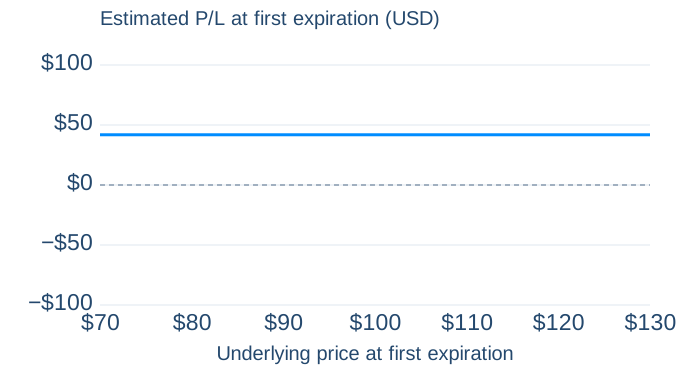
| Underlying price | Modeled P/L at day 30 |
|---|---|
| $80 | $41.85 |
| $90 | $41.85 |
| $100 | $41.85 |
| $110 | $41.85 |
| $120 | $41.85 |
Maximum Profit
There is no universal maximum profit without an exit rule. In the idealized first-expiration model below, the combined settlement and remaining value are constant across stock prices. In real trading, rates, dividends, spreads and settlement terms determine the result. If the near legs cash-settle and the far legs are left open, a later rise can generate unlimited profit on the remaining synthetic long.
Maximum Loss
The initial debit is not a maximum-loss bound. If both expirations are allowed to cash-settle with no hedge, the combined payoff per unit is later price minus earlier price minus the debit. Loss can be very large if the stock falls between the two dates. Across unrestricted price paths there is no fixed upper bound on that loss; conditional on a known earlier price, the later stock price has a floor of zero.
Breakeven Point(s)
For an unhedged position held through both cash settlements, breakeven requires the later price to exceed the earlier price by the $0.40 debit, before financing. If the earlier price is $100, the later breakeven is $100.40. If the whole position is closed at the earlier date instead, there is no single stock-price breakeven under the zero-dividend parity model: the financing spread sets the result.
Why the exit date matters
If the first settlement price is $100 and the second is $90, $100 or $110, the unhedged total results are −$1,040, −$40 and +$960. These are not the flat first-expiration line shown below. With physically settled shares, the first exercise or assignment can leave an offsetting stock holding; dividends, borrow and funding must then be included. Cash-settled and physically settled versions are not interchangeable.
Risks and Position Management
Small apparent pricing differences may disappear after commissions, financing and bid–ask spreads. American-style options add early-exercise and dividend risk. A missing or mismatched leg can create a large directional position. This is a specialist relative-value structure, not an assured retail arbitrage profit.
Before expiration, option prices also reflect time remaining and volatility. The chart depends on its model assumptions. Trading costs reduce profits and increase losses. Review the contract’s exercise and settlement rules before trading.
Explore the Position
Study the Synthetic Long Stock and Synthetic Short Stock components first. The standard expiration builder does not model a four-leg Jelly Roll across two settlements; combining its legs into one expiration would give a misleading result.
Related Strategies
Compare This Strategy
Optional further reading to help you compare the tradeoffs.
- Box Spread vs Jelly Roll — First identify what is closed or settled at each date.
Structure reference: Cboe Jelly Roll specification. Example premiums and calculations are illustrative. Editorial standards.