
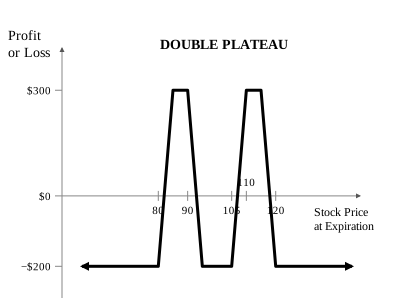
A Double Plateau combines two long Condors: one below the current price and one above it. It creates two separate flat profit regions. Unlike an Iron Condor, it can lose money when the price stays in the middle as well as when it moves beyond the outer wings.
Names and related structures: Paired bullish and bearish long Condors.
Market Outlook
The example needs a moderate move in either direction by expiration. A quiet market that finishes between the two Condors loses the entry debit. A very large move also loses the debit, so the position is not a substitute for a Long Strangle.
Position Construction
Build the lower put Condor with +1 $80 put, −1 $85 put, −1 $90 put and +1 $95 put. Build the upper Call Condor with +1 $105 call, −1 $110 call, −1 $115 call and +1 $120 call. Use one expiration and equal quantities.
| Action | Option | Expiration | Premium |
|---|---|---|---|
| Buy 1 | $80 put | Same expiry | $0.25 |
| Sell 1 | $85 put | Same expiry | $0.50 |
| Sell 1 | $90 put | Same expiry | $1 |
| Buy 1 | $95 put | Same expiry | $2.25 |
| Buy 1 | $105 call | Same expiry | $2.25 |
| Sell 1 | $110 call | Same expiry | $1 |
| Sell 1 | $115 call | Same expiry | $0.50 |
| Buy 1 | $120 call | Same expiry | $0.25 |
Example
Assume XYZ starts at $100. Each Condor costs $1 per share-equivalent, so the eight-leg position costs $200. At $87, the lower Condor has $500 intrinsic value and the upper one expires worthless: profit is $300. The same profit occurs at $112. At $100 both Condors expire worthless, losing $200. Below $80 or above $120 the net intrinsic value is also zero.
All amounts use a 100-unit contract multiplier and exclude commissions and fees. These prices illustrate the arithmetic; they are not current market quotes.
Payoff Diagram
Try the Double Plateau Calculator
| Underlying price | Expiration P/L |
|---|---|
| $75 | −$200 |
| $80 | −$200 |
| $82 | $0 |
| $85 | $300 |
| $90 | $300 |
| $93 | $0 |
| $100 | −$200 |
| $107 | $0 |
| $110 | $300 |
| $115 | $300 |
| $118 | $0 |
| $120 | −$200 |
| $125 | −$200 |
Maximum Profit
For the equal $5 wing widths in this non-overlapping example, maximum profit is ($5 − $2 total debit) × 100 = $300. It occurs from $85 to $90 and from $110 to $115. The two separate maxima must not be added: the stock cannot finish in both intervals at once.
Maximum Loss
Maximum loss is the $200 total debit. That occurs at or below $80, from $95 to $105, and at or above $120. These bounds assume all eight matched legs remain together until expiration.
Breakeven Point(s)
The four breakevens are $82, $93, $107 and $118. Profit is positive between $82–$93 and $107–$118. Overlapping Condors, unequal wings or a different debit require recalculation from all eight legs.
Double Plateau vs Batman
Both can show two profit regions. This paired-condor version buys outer protection and has flat tops. The double-ratio Batman leaves additional short options uncovered and has pointed peaks. Check all strikes and quantities when comparing the names.
Risks and Position Management
Eight legs can make spreads and transaction costs significant. A favorable move must be large enough to reach a profit region without overshooting it. Early assignment or closing only part of the trade can remove the original risk limit. The expiration chart does not predict the price of the options before expiry.
Before expiration, option prices also reflect time remaining and volatility. The expiration diagram does not show every interim gain or loss. Trading costs reduce profits and increase losses. Review the contract’s exercise and settlement rules before trading.
Explore the Position
Try the Double Plateau Calculator
Related Strategies
Structure reference: Strategy reference. Example premiums and calculations are illustrative. Editorial standards.
Advanced Strategy Variations
Build on the core strategies with these less common structures. Match the option legs and expirations when comparing names.