
A double diagonal combines a call diagonal with a put diagonal. It uses different strikes and expirations, aiming to benefit while the stock remains within a range. The version here buys a longer-dated straddle and sells a shorter-dated strangle. Other arrangements use different long strikes, so compare the actual legs.
Names and related structures: Call and put diagonal combination; Long Straddle with Short Strangle.
Market Outlook
The initial outlook is broadly neutral through the short expiration. Changes in implied volatility also matter because the long options retain time value. A quiet stock alone does not guarantee a gain if those options lose enough value.
Position Construction
Buy one 90-day $100 call and one 90-day $100 put. Sell one 30-day $95 put and one 30-day $105 call. All options refer to the same underlying and cover 100 shares per contract.
| Action | Option | Expiration | Premium |
|---|---|---|---|
| Sell 1 | $95 put | 30 days | $1.50 |
| Buy 1 | $100 put | 90 days | $5.50 |
| Buy 1 | $100 call | 90 days | $5.50 |
| Sell 1 | $105 call | 30 days | $1.50 |
Example
Suppose XYZ starts at $100. Pay $5.50 for each long option and collect $1.50 for each short option. The debit is $800. If XYZ is $100 at the first expiration, the shorts expire worthless. If the remaining straddle can then be sold for $9.70 per share, the total position earns $170 before costs. If it is worth only $7, closing it instead realizes a $100 loss. These are alternative exit prices, not promised outcomes.
All amounts use a 100-unit contract multiplier and exclude commissions and fees. These prices illustrate the arithmetic; they are not current market quotes.
Value at the First Expiration
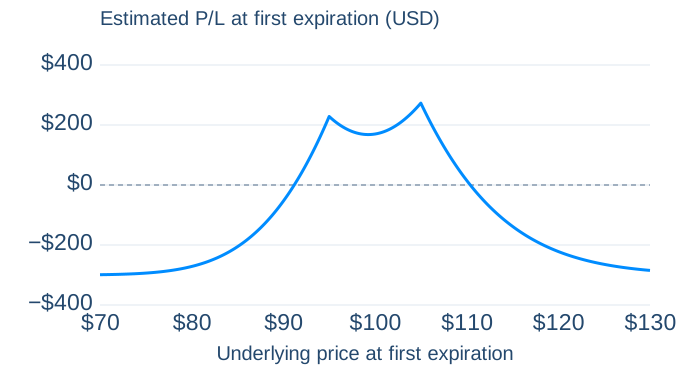
| Underlying price | Modeled P/L at day 30 |
|---|---|
| $80 | −$271.58 |
| $90 | −$53.80 |
| $95 | $228.38 |
| $100 | $169.89 |
| $105 | $272.95 |
| $110 | $15.32 |
| $120 | −$221.82 |
Maximum Profit
There is no fixed dollar maximum that can be read from the strikes alone at the first expiration. Profit equals the remaining straddle value minus the short options’ intrinsic value and the opening debit. Under a specified volatility model, local peaks may occur near the short strikes; the chart estimates those values, not a guaranteed maximum.
Maximum Loss
If both shorts expire worthless and the Long Straddle is later held until it expires worthless at $100, the $800 debit is lost. Closing all four options together at the first expiration also limits the theoretical loss to the debit under the zero-rate European model used below. That is not a lifetime loss guarantee if assigned shares, settled short losses or unhedged long options are carried through later price reversals.
Breakeven Point(s)
At the short expiration, solve: long call value + long put value − max($95 − S, 0) − max(S − $105, 0) = $8. The long values depend on time remaining and volatility, so there is no permanent pair of breakeven prices. Recalculate after changing either expiry or either long strike.
Risks and Position Management
Volatility can fall, bid–ask spreads can consume a small expected gain, and short assignments can require substantial funding. If the short legs settle and the long legs remain, subsequent moves create a different risk profile. Rolling is a new trade with new costs, not a way to preserve the original diagram.
Before expiration, option prices also reflect time remaining and volatility. The chart depends on its model assumptions. Trading costs reduce profits and increase losses. Review the contract’s exercise and settlement rules before trading.
Explore the Position
The Diagonal Spread Calculator can model each side separately. Use the same valuation date, volatility and rate assumptions, then add the two dollar results. Do not add the two sides’ individual maximum profits: they may occur at different stock prices.
Related Strategies
Compare This Strategy
Optional further reading to help you compare the tradeoffs.
- Iron Condor vs Double Diagonal — Choose between a fixed same-expiration payoff and an exposure that also depends on the term structure of volatility.
Structure reference: Strategy reference. Example premiums and calculations are illustrative. Editorial standards.
Advanced Strategy Variations
Build on the core strategies with these less common structures. Match the option legs and expirations when comparing names.