
A Jade Lizard combines a short put with a Bear Call Spread. The trader collects a premium and normally chooses a total credit greater than the call spread width. This can remove expiration loss on a large rise, but leaves substantial exposure to a falling stock.
Names and related structures: Short put with Bear Call Spread.
Market Outlook
The outlook is neutral to mildly bullish. The best result comes when the stock finishes between the two short strikes. A moderate rise or decline may still be profitable, depending on the opening credit.
Position Construction
Sell one lower-strike put, sell one higher-strike call and buy one call above the short call. All three options have the same expiration. There is no protective long put.
| Action | Option | Expiration | Premium |
|---|---|---|---|
| Sell 1 | $95 put | Same expiry | $3 |
| Sell 1 | $105 call | Same expiry | $3 |
| Buy 1 | $110 call | Same expiry | $0.50 |
Example
With XYZ at $100, sell the $95 put for $3 and the $105 call for $3, then buy the $110 call for $0.50. The $5.50 credit is $550 for one position. At $100, all three options expire worthless. At $120, the call spread costs $500 to settle, leaving $50 profit. At $80, the short put loses $1,500 before the credit, giving a $950 net loss.
All amounts use a 100-unit contract multiplier and exclude commissions and fees. These prices illustrate the arithmetic; they are not current market quotes.
Payoff Diagram
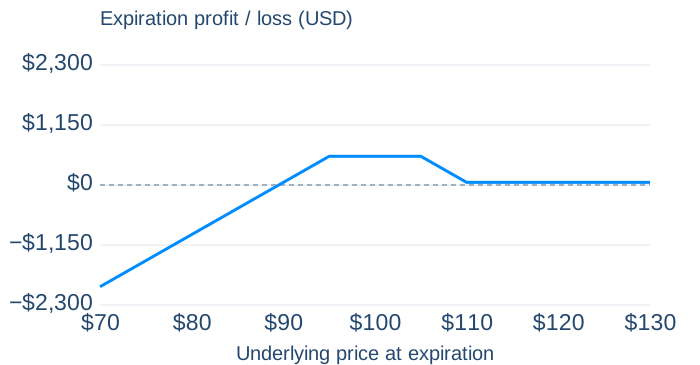
| Underlying price | Expiration P/L |
|---|---|
| $0 | −$8,950 |
| $80 | −$950 |
| $89.50 | $0 |
| $95 | $550 |
| $105 | $550 |
| $110 | $50 |
| $120 | $50 |
Maximum Profit
Maximum profit is the $550 opening credit, earned between $95 and $105 at expiration. A rise above $110 leaves $50, not the full credit.
Maximum Loss
If the stock reaches zero, loss = (put strike − total credit) × 100 = $8,950. This is finite because the stock cannot go below zero, but is large relative to the premium received. Margin required by a broker is not the maximum possible loss.
Breakeven Point(s)
The downside breakeven is put strike − credit: $95 − $5.50 = $89.50. Because the credit exceeds the $5 call spread width, there is no upside breakeven in this example. A credit below that width would leave upside loss and an additional breakeven.
Risks and Position Management
The short put is unprotected. Assignment can require $9,500 to buy 100 shares, and a decline can increase margin requirements before expiration. “No upside risk” describes only the matched expiration payoff when the credit covers the call width; it does not eliminate execution, assignment or funding risk.
Before expiration, option prices also reflect time remaining and volatility. The expiration diagram does not show every interim gain or loss. Trading costs reduce profits and increase losses. Review the contract’s exercise and settlement rules before trading.
Explore the Position
Open this example in the Advanced Strategy Builder. The example legs, quantities and premiums are filled in so you can change them and compare expiration outcomes.
Related Strategies
Compare This Strategy
Optional further reading to help you compare the tradeoffs.
- Jade Lizard vs Iron Condor — The decision is whether to retain a firm downside limit, not just which position collects more premium.
- Jade Lizard vs Reverse Jade Lizard — Identify which large move would hurt before comparing the credits.
Structure reference: Strategy reference. Example premiums and calculations are illustrative. Editorial standards.
Advanced Strategy Variations
Build on the core strategies with these less common structures. Match the option legs and expirations when comparing names.